
This project examines emergency dispatch as a socio-technical design problem. Through multi-sited ethnographic fieldwork in Italian emergency control rooms, ground-based services, and helicopter operations, it explores how operators build situational understanding under uncertainty. These findings are translated into a functioning CAD (Computer-Aided Dispatch) prototype, designed to support progressive workflows, reduce fragmentation, and improve missions coordination in life-critical contexts.


“Emergency response is usually seen only at its most visible moment. But the chain of care starts earlier, inside Public Safety Answering Points.”
This project began from a simple shift in perspective: before an ambulance arrives or a helicopter takes off, someone has to answer a call, interpret incomplete information, locate the event, assess urgency, and activate the right response. That hidden layer is where emergency care first becomes operational.

“Dispatch is an interface problem before it is a medical one.”
In the first moments of an emergency, medicine is mediated through information: partial, emotional, contradictory, and time-sensitive. This means the quality of care depends not only on clinical expertise, but also on how effectively a socio-technical system can transform uncertainty into coordinated action.

An interdisciplinary design project for critical systems
This work sits at the intersection of ethnographic research, interaction design, service design, cognitive ergonomics, and emergency systems thinking. Rather than treating dispatch as a purely technical software problem, the project approached it as a socio-technical design challenge involving interfaces, workflows, coordination, information architecture, and operational resilience.
Project numbers
These figures give a sense of the scale and depth of the fieldwork behind the project. Rather than being built from a distance, the work developed through direct immersion in emergency environments, across control rooms, rescue bases, and operational contexts.
740+
Hours on field
4
Sites visited
3
Italian regions
From fieldwork to prototype. A CAD system answering real operational needs.
The outcome is a functional prototype, designed and developed as a real interactive system to test a different operational logic for call-taking, triage, and dispatch.
- Communication Panel. See lines status, answer incoming calls, and place outgoing calls.
- New mission. Build a mission record, from location and patient details to triage, dispatch support, and pre-arrival guidance.
- Highway resolver. Supports incidents on highways and other major roads, with advanced location search and intervention recommendations based on official protocols.
- Mission management. Monitor ongoing and queued missions, search past or active records, and inspect key details without fully opening the case.
- Unit status overview. Track the status, location, and assignment of available and engaged resources across the territory.
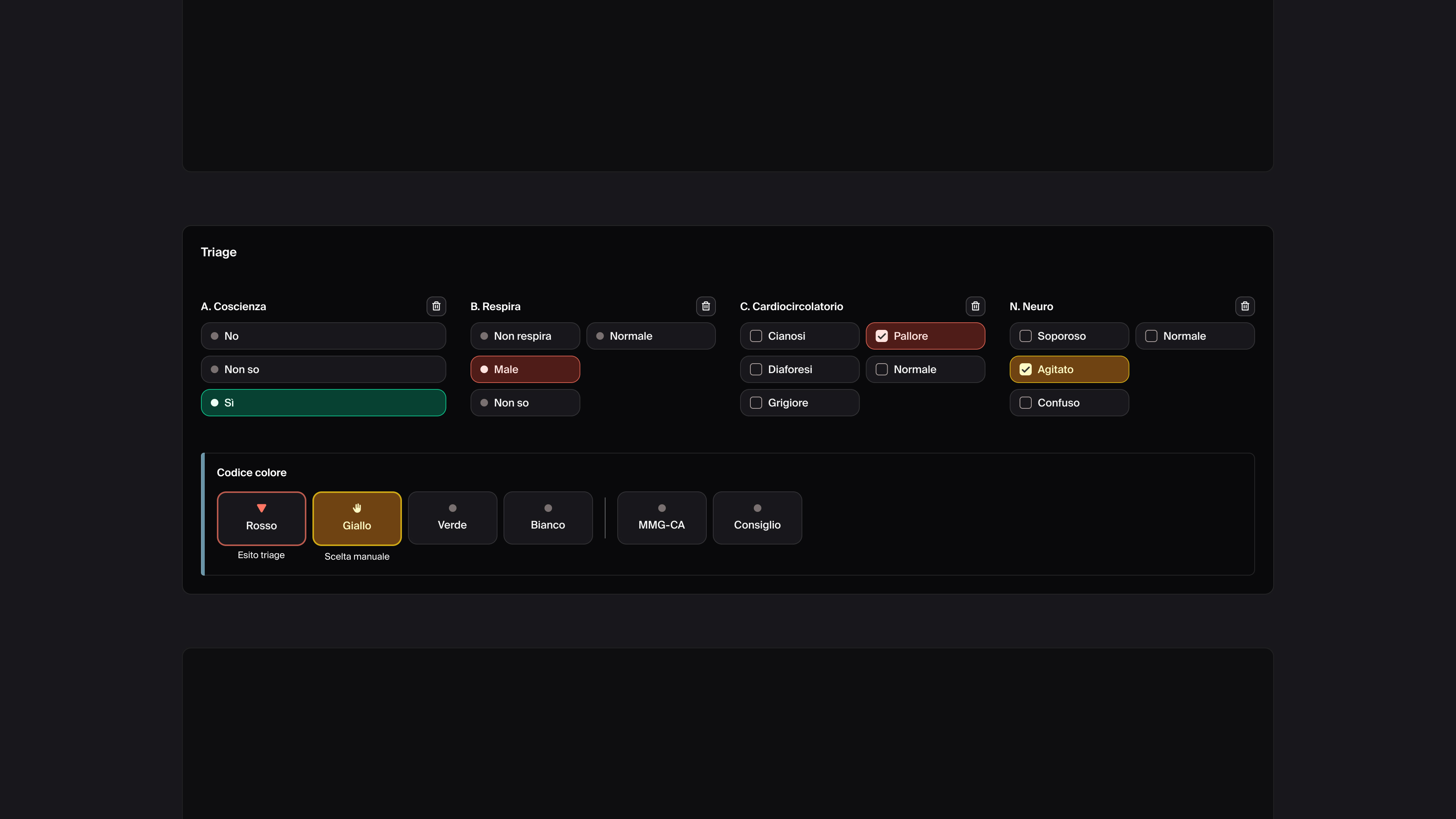
Streamlined decision-making with Quick Triage
In highly critical emergencies, standard assessment protocols can take too long. To support operators when every second counts, the CAD prototype includes a Quick Triage module. By bypassing full questionnaires and relying strictly on four vital parameters—Consciousness, Breathing, Circulation, and Neurological status—the interface allows dispatchers to instantly generate a priority color code, reducing cognitive load and drastically speeding up the dispatch of rescue units.
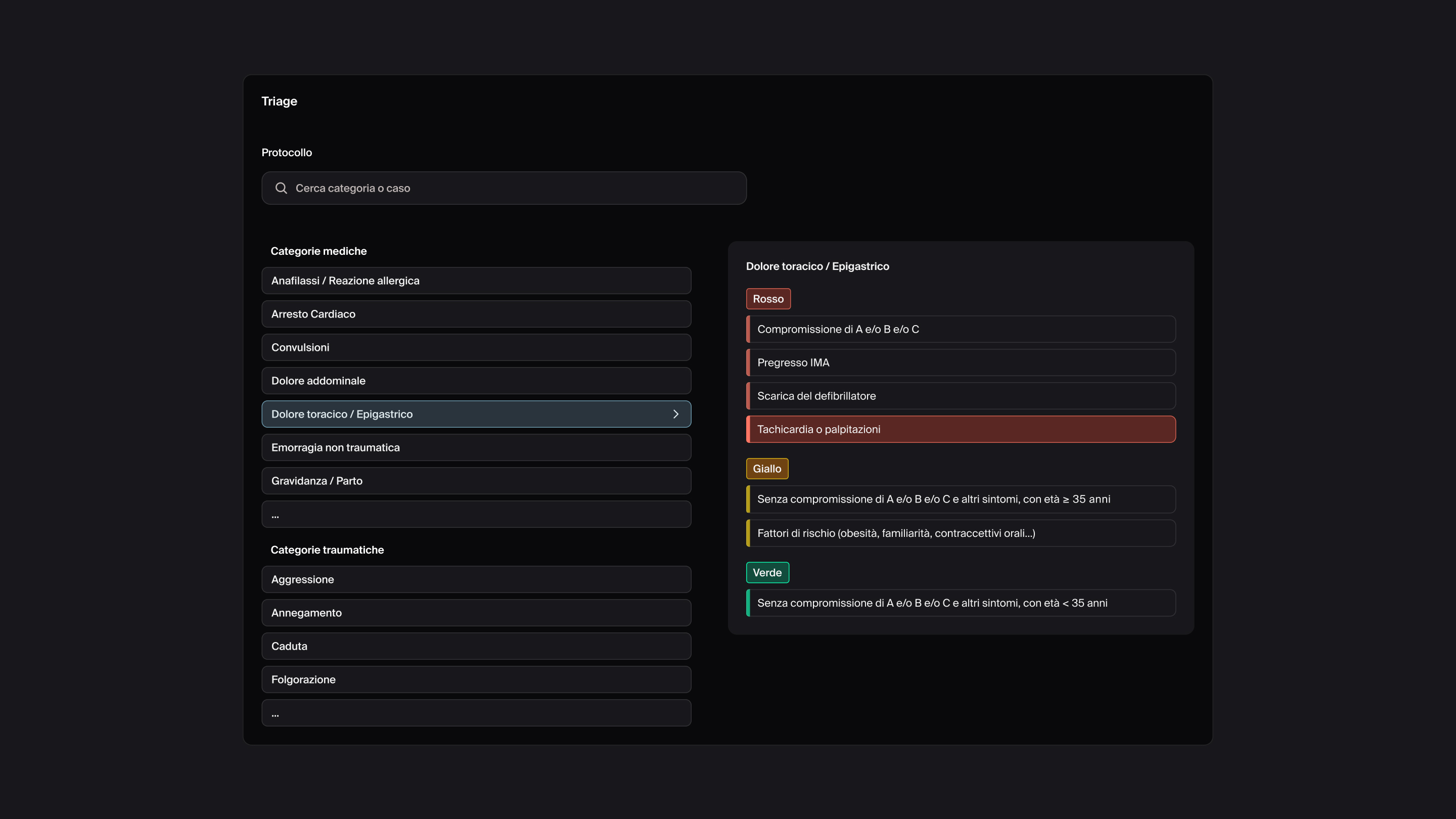
Structured assessment and protocol search
While Quick Triage manages the most time-critical events, the majority of emergencies rely on full clinical protocols. This section of the interface allows operators to efficiently browse standard operating procedures, which are logically grouped by category and specific case. Since each selected case automatically determines the mission’s color code, accuracy is paramount. A prominent search feature lets dispatchers bypass manual navigation, quickly filtering through conditions to find the right protocol in seconds without breaking conversation with the caller.
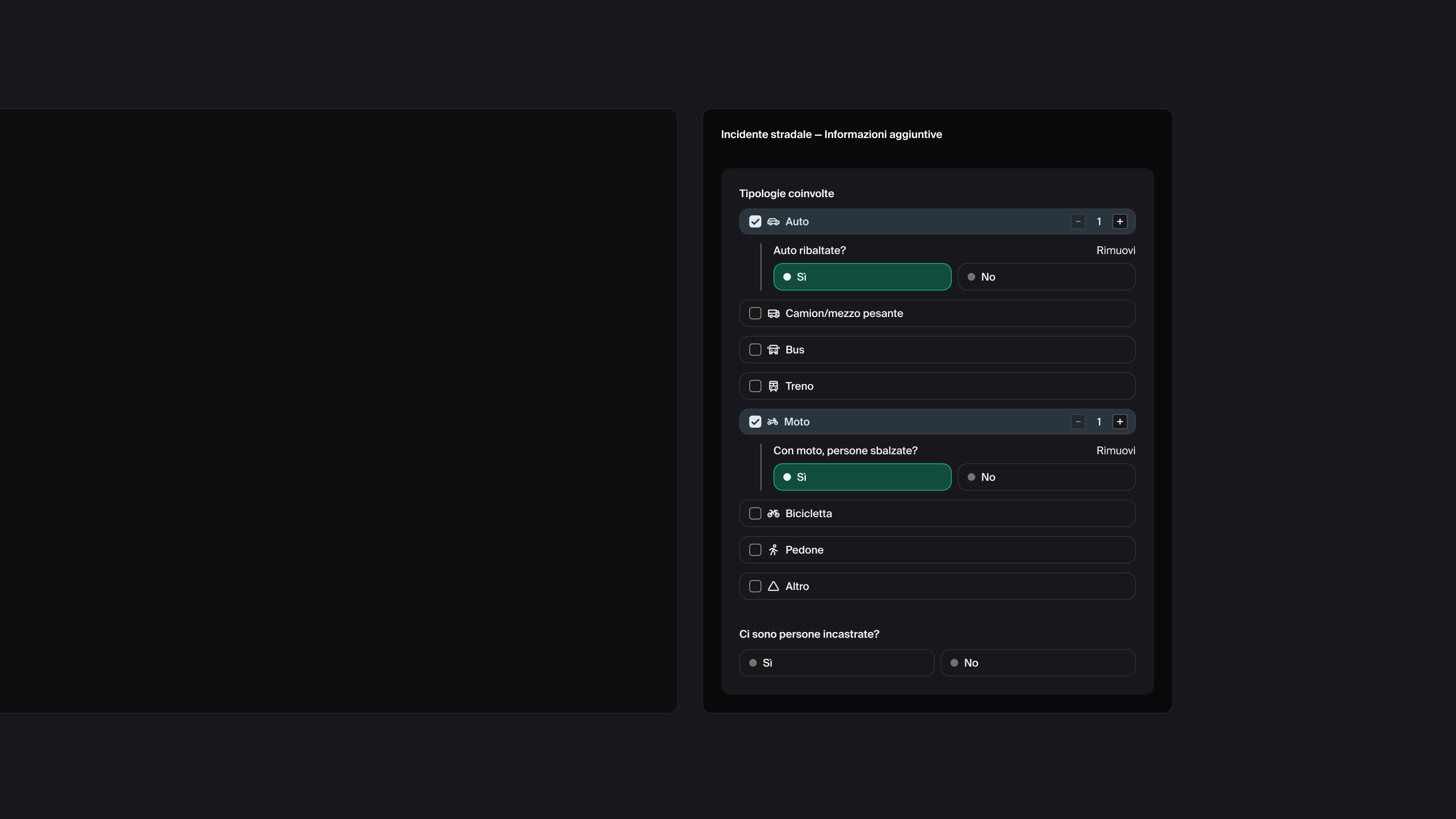
Aided collection of important additional information
Some emergencies require additional information to support both the immediate response and subsequent clinical decisions. Conditional input controls adapt to the selected emergency type, guiding operators to capture only the details that matter — such as the number and type of vehicles involved in a traffic accident, the number of patients, or when CPR was started in a cardiac arrest. This helps build a clearer picture of the situation while providing the information needed to evaluate time-sensitive pathways such as ECMO.
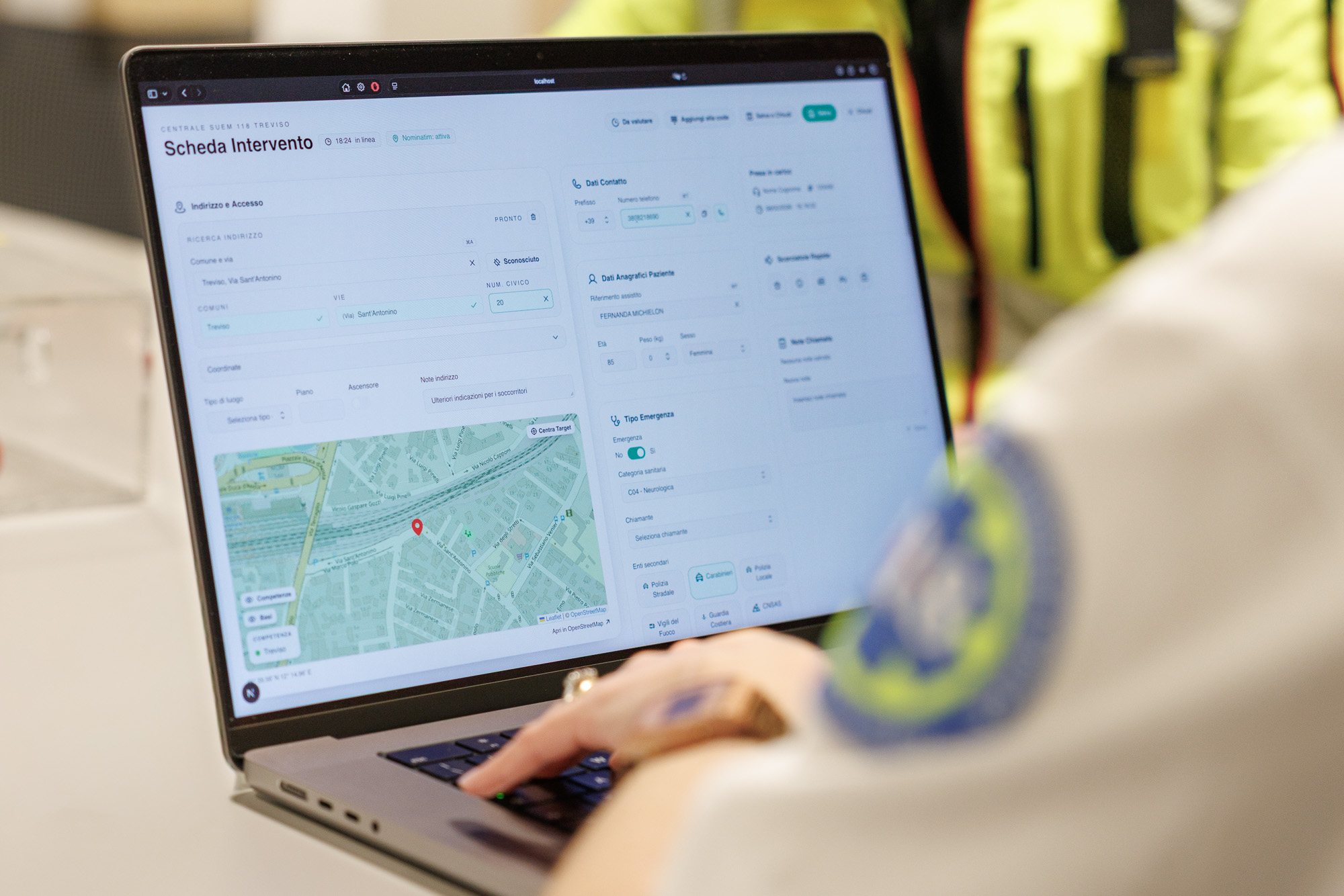
Validating the system through live simulation with actual users
Scenario-based testing moved evaluation beyond static screens, reproducing the non-linear and time-pressured nature of real emergency calls, where information emerges and is progressively refined.
Two complementary setups were used. Active control-room nurses tested the prototype against established workflows and real operational practices. In parallel, an emergency-room physician with no prior CAD experience acted as the operator while a nurse played the caller, helping assess whether the interface could be understood without relying on familiarity with legacy systems. Observations from both simulations directly informed iterative design improvements.
The question is not whether emergency systems can function without design. Clearly, they already do.
The question is whether they could function better, more safely, and with less cognitive burden if design were treated as a core competence from the beginning. Emergency infrastructures are not outside the scope of design. They are precisely where design can matter most: saving lives.